

Consumer Health
BEROCCA IMMUNO
Consumer Health
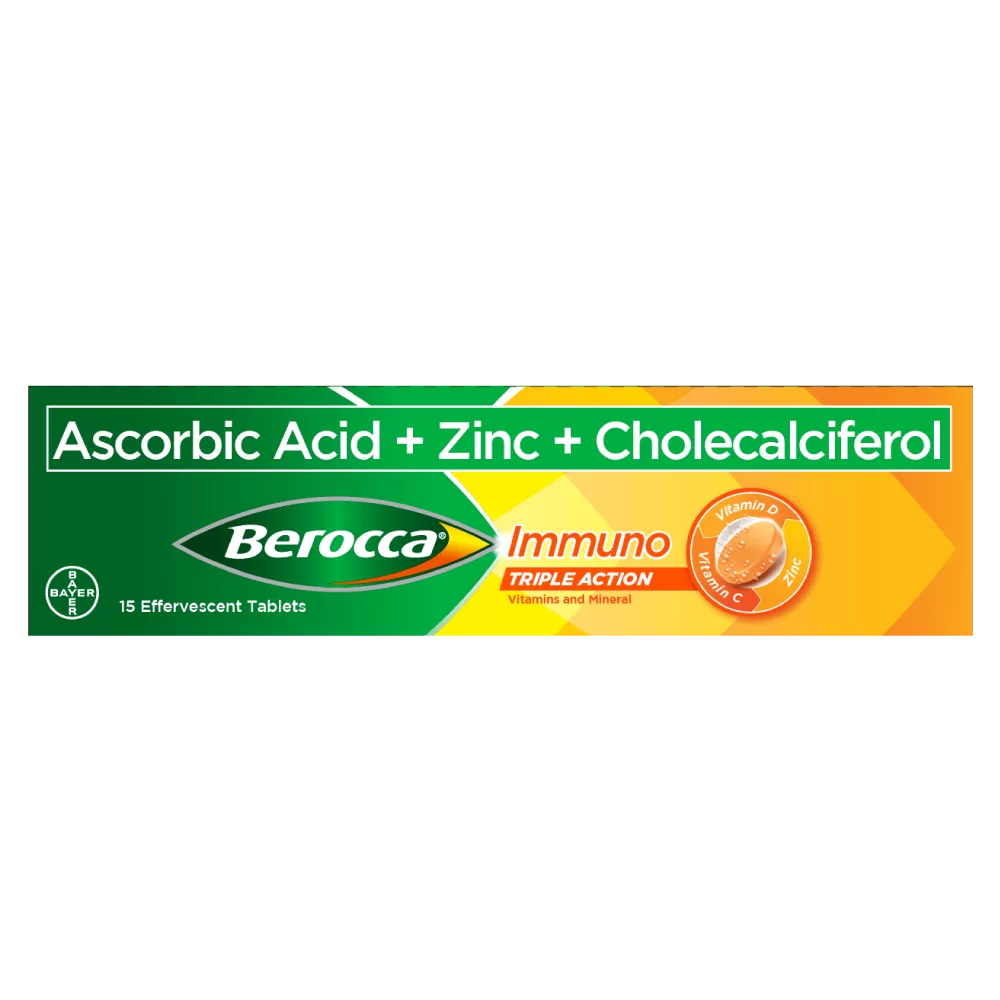
Ascobic Acid + Zinc + Cholecalciferol
BEROCCA® IMMUNO
Effervescent Tablet
Vitamins and Mineral
1g/10mg/400IU
1. Name of the Product
Ascorbic Acid + Zinc + Cholecalciferol (Berocca® Immuno) Triple Action Effervescent Tablet.
2. Description of the Product
This product is a preparation containing Ascorbic Acid (Vitamin C), Zinc and Cholecalciferol (Vitamin D3).
3. What is in the medicine?
COMPOSITION
Each effervescent tablet contains:
Ascorbic Acid............................................................. 1g
Zinc............................................................................ 10mg
Cholecalciferol (Vitamin D3)...................................... 400IU
4. Strength of the Medicine
This product is a preparation containing Ascorbic Acid (Vitamin C), Zinc and Cholecalciferol (Vitamin D3). Refer to composition listed in number 3.
5. What is this Medicine used for?
The treatment of Vitamin C, Vitamin D and Zinc deficiency.
This product is indicated for the prevention and treatment of Vitamin C, Vitamin D and Zinc deficiencies during situations and conditions with increased requirements or increased risk of deficiencies.
Further, Vitamin C, Vitamin D and Zinc are independently essential for the defense potential and disease resistance mechanisms of the body.
6. How much and how often should you use this Medicine?
For adults and children above 12 years of age, dissolve 1 tablet per day in a glass of water. Do not exceed the recommended daily intake.
7. When should you not take this Medicine?
The product is not suitable for individuals with following conditions:
- Hemochromatosis (iron overload in body)
- Hypercalcemia (elevated calcium level in the blood)
- Kidney disease/ disorders (Severe renal insu cency (GFR <30ml/min), including individuals on dialysis, Nephrolithiasis or history of nephrolithiasis, Hyperoxaluria)
- Hypervitaminosis D (abnormally high level of Vitamin D)
- Hypersensitivity to any of the active substances or to any of the excipients
8. Care that should be taken when taking this Medicine?
Do not exceed the labelled dose. Acute and chronic overdose increases risk of adverse effects.
Use caution with concomitant intake of food supplements or medication containing Vitamin C, Vitamin D, Vitamin D analogues, and/or Zinc. Separate intake of the product from other medication by 4 hours unless otherwise specified. Vitamin C may interfere with laboratory tests resulting in false reading.
Inform your physician or health care professional when taking the product and laboratory tests are planned. Vitamin C may interfere with testing kits and meters that measure glucose levels resulting in false readings. This should be taken into consideration by individuals on a controlled sodium diet.
PREGNANCY
The product is generally considered safe during pregnancy. However, given the amount of Vitamin C, a healthcare professional should be consulted before the use of the product. The labeled dose should not be exceeded since chronic overdose might be harmful to the fetus. Allowance should be made for intake of the Vitamins and Zinc from other sources.
LACTATION
The product is generally considered safe during lactation. However, given the amount of Vitamin C, a healthcare professional should be consulted before use of the product. The Vitamins and Zinc in the product are excreted into breast milk. This should be taken into consideration.
FERTILITY
There is no evidence suggestive that normal endogenous levels of the Vitamins and Zinc cause any adverse reproductive effects in humans.
9. Undesirable Effects of this Medicine
The frequency of listed events is not known based on available data.
Gastrointestinal Disorders
Diarrhea, nausea, vomiting, gastrointestinal and abdominal pains
Immune System Disorders
Allergic reaction and anaphylactic reaction
Hypersensitivity reactions with respective laboratory and clinical manifestations include allergic asthma syndrome, mild to moderate reactions potentially affecting skin, respiratory tract, gastrointestinal tract, and cardiovascular system including symptoms such as rash, urticaria, allergic edema and angioedema, pruritus, and cardio-respiratory distress.
If an allergic reaction is suspected, use of the product must be stopped and a healthcare professional must be consulted.
10. What other medicine or food should be avoided while taking this Medicine?
ACTIVE INGREDIENT | DRUG | DESCRIPTION |
Ascorbic Acid (Vitamin C) | Desferrioxamine | Vitamin C may enhance tissue iron toxicity, especially in the heart, causing cardiac decompensation. |
| Iron | Vitamin C may enhance iron absorption, especially in individuals with iron deficiency. Small incremental increases of in iron could be important in subjects with conditions such as hereditary hemochromatosis or in subjects heterozygous to this condition, as it may exacerbate iron overload. | |
| Cyclosporine | Antioxidant supplementation including Vitamin C may reduce cyclosporine blood level. | |
| Indinavir (protease inhibitors) | High dose Vitamin C significantly reduced the serum concentration of indinavir, which may interfere with the effectiveness of indinavir. | |
| Warfarin | High dose Vitamin C may interfere with the effectiveness of warfarin. | |
Cholecalciferol (Vitamin D3) | Thiazide diuretics | Thiazide diuretics reduce the urinary excretion of Calcium. Caution should be used with concomitant Vitamin D treatment. Serum calcium should be regularly monitored during concomitant use with thiazide diuretics. |
| Orlistat | Some medication may decrease the gastro-intestinal absorption of Vitamin D. Separation of intake between these medications and Vitamin D by at least 2 hours before or 4-6 hours after Vitamin D intake should minimize this interaction. | |
| Iron exchange resins (e.g. cholestyramine) | ||
| Laxatives (e.g. mineral oil, senna) | ||
| Vitamin D analogues (e.g. ergocalciferol, calcitriol, and topical calcipotriene) | Concomitant treatment with Vitamin D analogues should be avoided due to increased risk of hypervitaminosis D and/or hypercalcaemia. | |
Zinc | Tetracycline antibiotics | Polyvalent cations, such as Zinc, form complexes with certain substances resulting in decreased absorption of both substances. Separate intake of the product either 2 hours before or 4 hours after other medication, unless otherwise specified, reduces the potential for this interaction |
| Quinolone antibiotics | ||
| Penicillamine | ||
| Biphosphonates | ||
| Levothyroxine | ||
| Eltrombopag |
11. What should you do if you miss a dose?
No available information.
12. Signs and Symptoms of Overdose
There is no evidence that this product can lead to an overdose when used as labeled. Allowance should be made for intake of the Vitamins and Zinc from other sources.
General manifestations of overdose may include increase of gastrointestinal disturbances including diarrhea, nausea, and vomiting.
If such symptoms occur, the product should be stopped and a healthcare professional must be consulted.
Acute or chronic overdose of the product may cause specific toxicity associated with either Vitamin C, Vitamin D, and/or Zinc.
Clinical signs and symptoms, laboratory findings, and consequences of overdose are highly diverse, dependent on an individual’s susceptibility, and surrounding circumstances. Specific clinical manifestation (i.e. with intake up to 10 times the labelled dose) may include the following:
Ascorbic Acid (Vitamin C)
Acute or chronic overdose of Vitamin C (>2g/ day in adults) may significantly elevate serum and urinary oxalate levels. In some instances, this results in hyperoxaluria, calcium oxalate crystalluria, calcium oxalate deposition, kidney stone formation, tubulointerstitial nephropathy, and acute renal failure.
Overdose of Vitamin C in individuals with glucose-6-phosphate dehydrogenase deficiency (>3g/ day in children and >15g/ day in adults) may result in oxidative hemolysis or disseminated intravascular coagulation.
Cholecalciferol (Vitamin D3)
Chronic ingestion of Vitamin D in excess of 400 IU/day (100 mcg/day) increases risk of hypervitaminosis D. Many of the effects of chronic Vitamin D toxicity are due to induced hypercalcemia and hypercalciuria. Symptoms may include anorexia, nausea, vomiting, weight loss, polyuria, heart arrhythmia, fatigue and soft tissue calcification.
Material hypercalcemia, possibly caused excessive Vitamin D intake during pregnancy, has been associated with hypercalcemia in neonates, which may lead to supravalvular aortic stenosis syndrome, the failures of which may include retinopathy, mental or growth retardation, strabismus and other effects.
Zinc
Zinc overdose (>40 mg/ day in adults) can cause diarrhea, irritation, and corrosion of the gastrointestinal (GI) tract, acute tubular necrosis, interstitial nephritis, copper deficiency, sideroblastic anemia and myeloneuropathies.
If overdose with the product is suspected, intake should be stopped and a healthcare professional consulted for treatment of clinical manifestations.
13. What to do when you have taken more than the recommended dosage?
There is no specific antidote, however patients should still consult their physician.
14. How should you keep this Medicine?
STORAGE CONDITION
Store at temperatures not exceeding 30ºC. Keep out of reach of children.
15. When should you consult your doctor?
If symptoms of overdosage occur, the product should be stopped and a health care professional consulted.
16. Name and Address of Marketing Authorization Holder
Bayer Philippines, Inc.
8th Floor Science Hub Tower 1, Campus Avenue Corner Turin St., McKinley Hill Cyberpark, Pinagsama, Taguig City
17. Name and Address of Manufacturer
PT. Bayer Indonesia
Jalan Raya Jakarta Bogor KM 32,
Cisalak, Kec. Sukmajaya, Kota Depok, Jawa Barat, Indonesia
18. ADR Reporting Statement
If you want to report a product complaint or side effect, please contact your health care professional or the Philippine FDA at adr@fda.gov.ph
Inquiries can also be directed to: Bayer Philippines, Inc.
Taguig City, Philippines
E-mail: MedInfoCH-PH @bayer.com drugsafety.philippines@bayer.com
19. Registration Number
Tube: DR-XY4193
Sachet: DR-XY48653
20. Date of First Authorization/ Renewal of the Authorization
DR-XY4193 (Tube): 11 March 2021
DR-XY48653 (Sachet): 15 March 2023
21. Date of Revision of Patient Information Leaflet
July 2023 (based on CCDS version 1.0 dated 22 May 2015)